Afrah Nazar / Research / Decision circuit
Individual report · since January 2026From Criterion to Verdict: How a Language Model Decides Eligibility for Clinical Trials
AI can judge whether a patient qualifies for a clinical trial — but not faithfully explain why.
- 1,152attention heads searched
- 6heads in the circuit
- 5patient records, hand-validated
- 100test patients, ablation
The problem
A language model can be handed a trial’s eligibility criteria and a patient’s record and asked for a verdict, and it will give one. In medicine an unexplained verdict cannot be trusted, and the explanation a model writes for itself is not guaranteed to be faithful to how it actually reached the answer. The question this project asks is narrower and more mechanical: which parts of the network carry the decision, and what does each of them do?
Approach
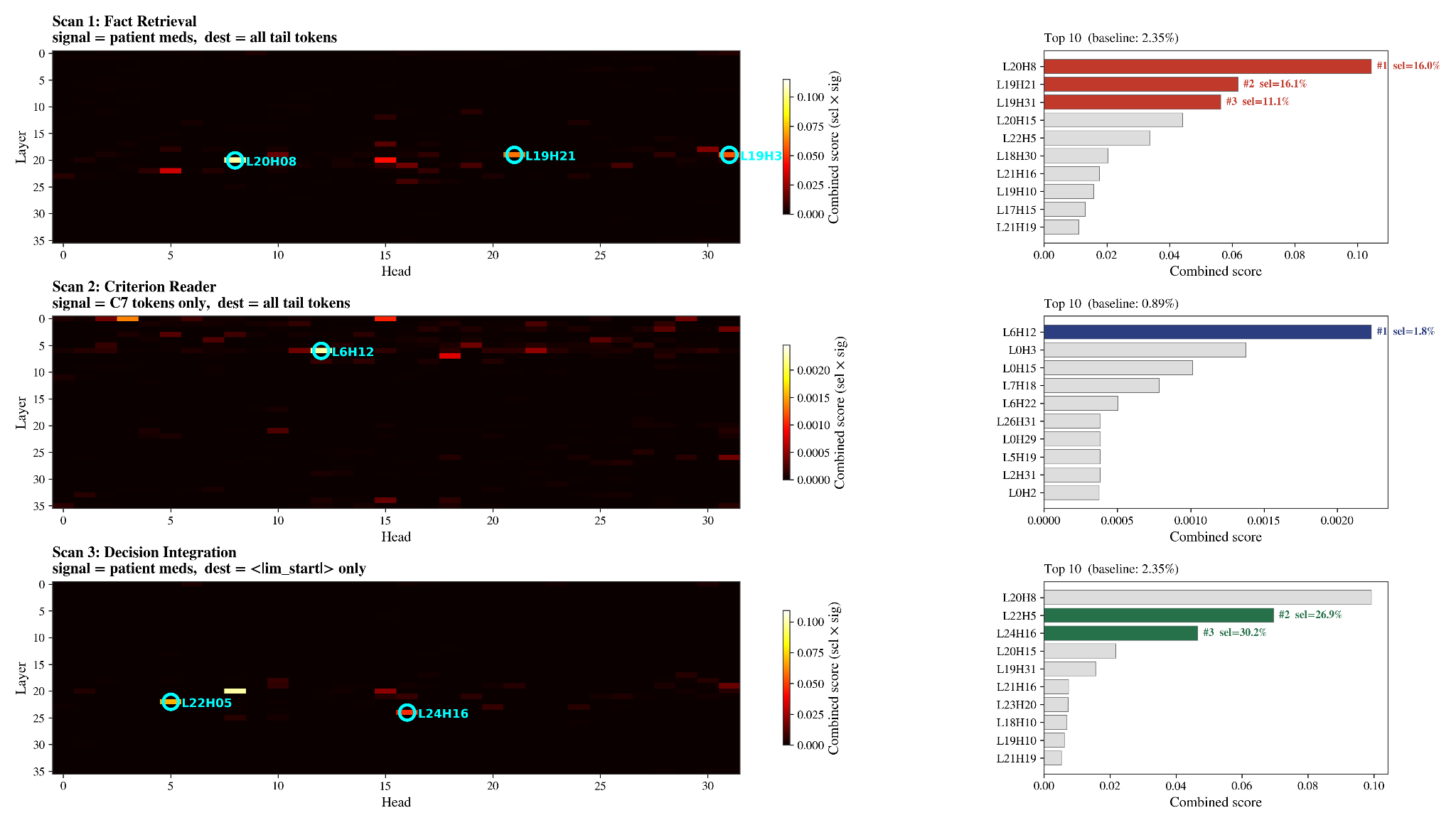
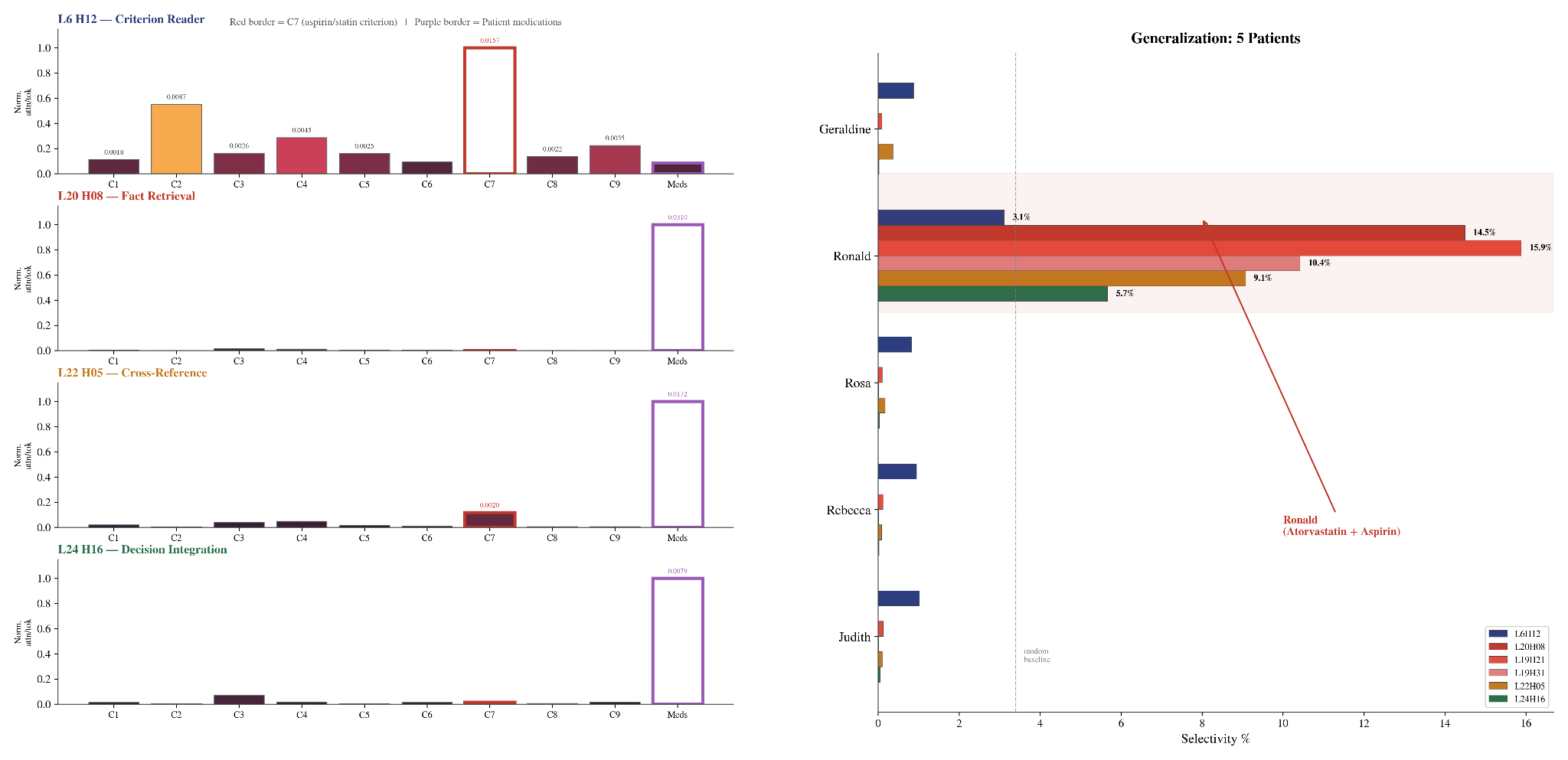
I searched all 1,152 attention heads of Qwen3-8B (36 layers × 32 heads), the open-source model used across my clinical-trial work. Each head was scored on how selectively it attended to the tokens that should matter, in three separate scans — one with the eligibility criterion as the signal, one with the patient’s medications, and one looking only at what feeds the model’s final answer. The highest-scoring heads from each scan were then validated by hand on five patient records.
What the circuit looks like
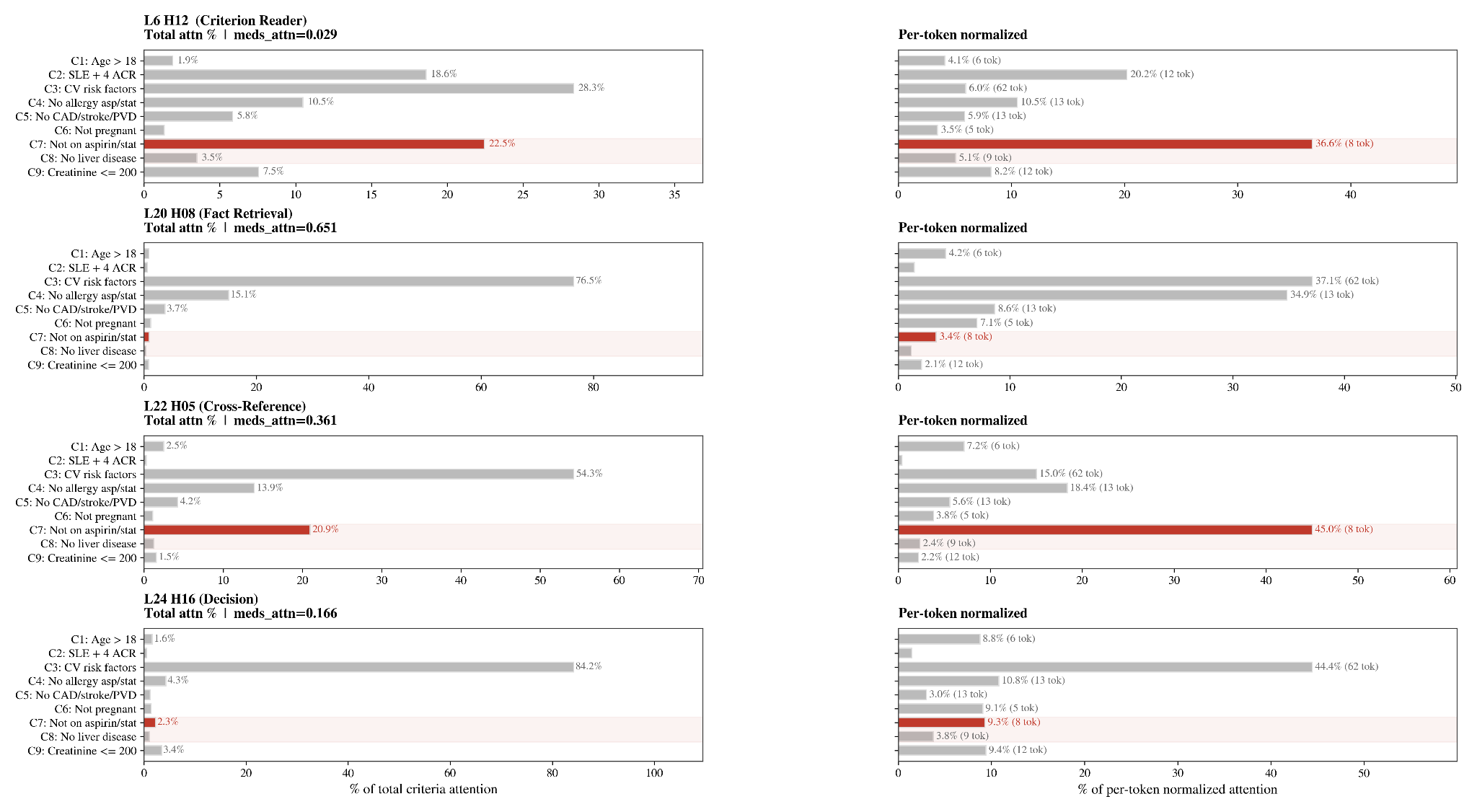
Six heads account for the decision. One, early in the network, reads the eligibility rule. Three retrieve the patient’s medications. One cross-checks the two, and one delivers the verdict. Ablating even one of the six sharply degrades accuracy across 100 test patients.
- Criterion reader — layer 6, head 12
- Fact retrieval — layer 19 heads 21 and 31; layer 20 head 8
- Cross-reference — layer 22, head 5
- Decision integrator — layer 24, head 16
Limitations
What’s next
The report is being revised toward a submission to the Regeneron Science Talent Search in 2027. Two researchers now advise it — one in computer science, one in psychology — after I cold-messaged more than eight of them across the country and two said yes. More on how that happened.